

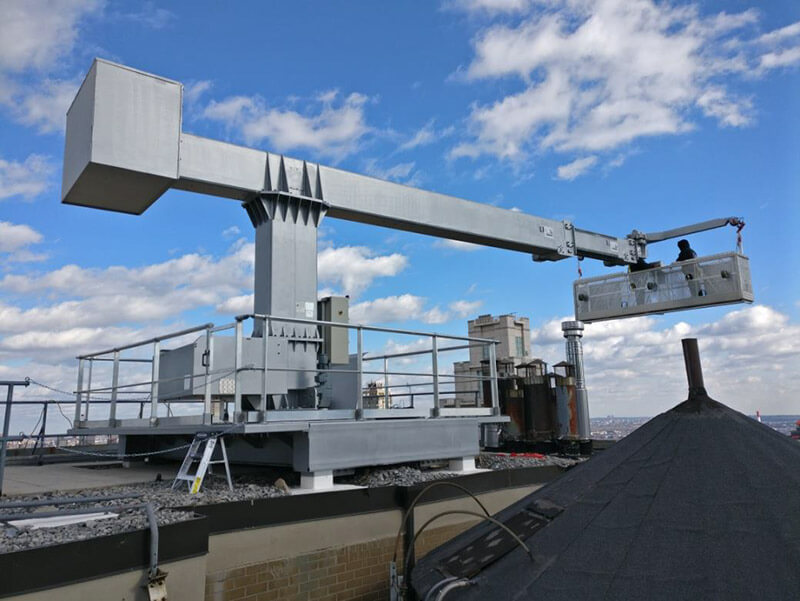
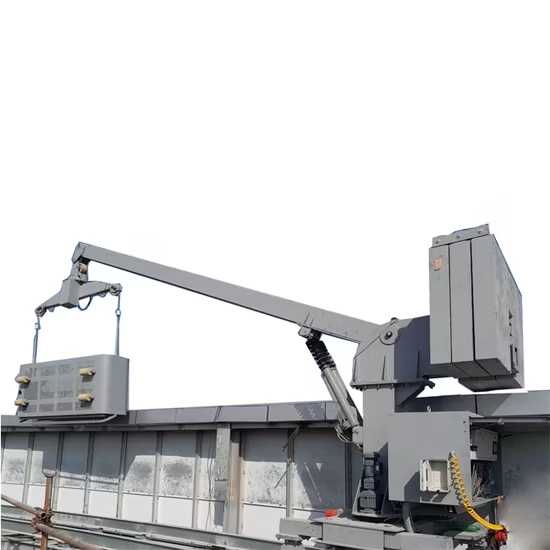
Building Maintenance Units (BMU) represent the most sophisticated solution for accessing the façades of modern skyscrapers and complex architectural structures. As buildings grow taller and their geometries more intricate, the demand for high-capacity, automated access systems has become a critical necessity. Unlike manual methods, these units are permanent mechanical installations capable of transporting heavy loads and personnel to any point on a building’s exterior.
Integrating a high-performance Building Maintenance Units (BMU) system into a building’s lifecycle ensures that cleaning and inspections are conducted with maximum efficiency while adhering to international safety mandates.
1. The Core Engineering of Modern Systems
The mechanical power of these units is governed by complex control systems that ensure every movement—whether traversing, hoisting, or slewing—is perfectly synchronized.
A. Custom Integration and Load Management
Every installation is a bespoke project, tailored to the specific weight-bearing capacity and height of the skyscraper. These Building Maintenance Units (BMU) are designed to handle not just the weight of the cradle, but also the dynamic forces exerted by wind. High-quality systems incorporate sensors that provide real-time data, ensuring the equipment never exceeds its safety parameters.
B. Traversing and Telescopic Capabilities
To reach the furthest corners of a complex façade, the jib often features telescopic and traversing tracks. These mechanisms allow the cradle to navigate around balconies and overhangs. The precision is so fine that the unit can be positioned within centimeters of the glass without making contact.
2. Multi-Layered Safety Architectures
Safety is the most critical aspect of any high-altitude operation. Modern engineering has introduced several “fail-safe” layers to prevent accidents before they occur.
C. Anti-Collision and Wind Monitoring
At high altitudes, wind is the greatest threat. Modern Building Maintenance Units (BMU) are equipped with ultrasonic anemometers that constantly monitor speeds. If gusts exceed a pre-set threshold, the system initiates a safe-docking procedure. Additionally, anti-collision sensors prevent the cradle from making accidental contact with the building’s glazing.
D. Emergency Descent and Overload Protection
In the rare event of a power failure, secondary safety systems take over. Emergency manual descent mechanisms allow the cradle to be lowered safely without electrical power. Furthermore, overload protection sensors in the Building Maintenance Units (BMU) immediately halt movement if the system detects weight beyond its certified limit.
3. Compliance and Life-Cycle Reliability
For developers, the reliability of an access system is directly linked to its compliance with global engineering standards.
E. Adherence to EN 1808 Standards
Every certified system must meet the rigorous requirements of EN 1808. From the thickness of the steel to the redundancy of the braking systems, Building Maintenance Units (BMU) must undergo strict testing. In regions like the Middle East, compliance with Saudi Civil Defense regulations is also mandatory to ensure fire and life safety.
F. Turnkey Support and Maintenance
The operational life of these units can span several decades if maintained correctly. A turnkey approach—from concept design to annual maintenance—ensures the system remains in peak condition. Regular load testing is essential to maintaining the certification of your Building Maintenance Units (BMU) infrastructure.
4. Safety by Design
Investing in high-quality maintenance infrastructure is a commitment to the building’s longevity. Building Maintenance Units (BMU) provide a permanent, powerful, and precise platform for the ongoing care of the world’s most impressive architectural achievements.
References
-
-
EN 1808: Safety requirements for suspended access equipment – Design, calculations, and tests.
-
ISO 9001:2015: Quality management systems for the design and manufacture of lifting equipment.
-
Saudi Civil Defense: Technical regulations for the installation and maintenance of Building Maintenance Units (BMU).
-
ASME A120.1: Safety requirements for powered platforms for building maintenance.
-